As of April 2026, the global logistics and transportation industry is facing a severe challenge: skyrocketing fuel costs. Driven by escalating geopolitical uncertainty in the Middle East, supply constraints, and ongoing energy market volatility, the price of fuel has surged to historic highs.
For businesses relying on supply chains, these rising costs are no longer just a distant economic indicator—they are directly impacting warehousing, ocean freight, air freight, and local distribution. In this article, we explore the root causes of this fuel crisis, how it is reshaping global freight, and the specific impact it is having on Hong Kong’s local logistics sector.
The Geopolitical Drivers of the 2026 Fuel Crisis
The current spike in fuel prices is primarily driven by the intensification of the Middle East conflict. Following joint US and Israeli strikes on Iran in late February 2026, crude oil prices surged by approximately 50% [1]. The conflict has severely disrupted the Strait of Hormuz, a critical maritime chokepoint through which roughly 20 million barrels of crude oil and oil products moved daily in 2025 [2].
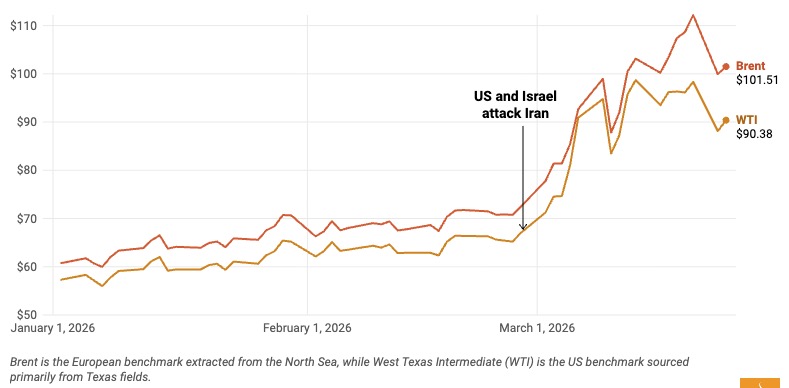
This disruption has been described by industry experts as one of the largest supply shocks in the history of oil markets [3]. With Brent crude exceeding $104 per barrel, the ripple effects are being felt across every mode of global transportation [4].
Air and Ocean Freight: Surcharges and Capacity Constraints
The international freight market has been hit particularly hard by these energy shocks.
- Air Freight: Aviation fuel costs have surged by over 90% compared to pre-conflict levels [4]. In response, airlines have been forced to pass these costs onto shippers through significantly higher jet fuel surcharges. Furthermore, airlines are actively avoiding Middle Eastern airspace, rerouting flights via longer northern or southern corridors. This not only increases fuel consumption but has also temporarily removed 12% to 20% of global air cargo capacity from the market [4]. Consequently, air freight rates from China to Europe have spiked by over 75%, while rates to the United States have increased by roughly 20% [4].
- Ocean Freight: The maritime sector is facing similar pressures. With commercial vessels being targeted or forced to turn back near the Persian Gulf, ocean carriers are implementing war-risk insurance surcharges and elevated bunker adjustment factors (BAF) [5]. The rerouting of ships adds days to transit times, tying up vessel capacity and driving up the baseline cost of ocean freight.
The Local Impact: Hong Kong’s Record-High Gasoline Prices
While global freight rates dominate international headlines, the local impact in Hong Kong is equally severe. Because Hong Kong imports almost all of its energy, it is highly vulnerable to global price shocks.
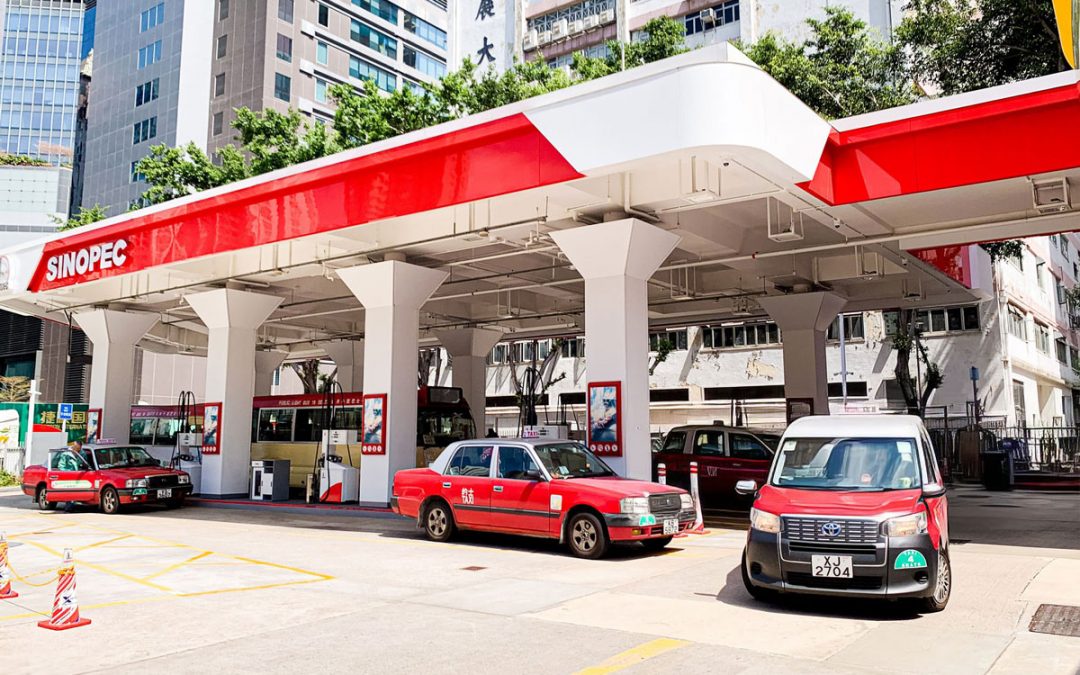
As of early April 2026, Hong Kong officially records the highest gasoline prices in the world [6]. The pump price for standard petrol has reached HK$32.39 per litre (approximately US$4.13 per litre) [7]. To put this into perspective, the global average price of gasoline is currently around US$1.42 per litre, meaning Hong Kong drivers and businesses are paying nearly three times the global average [6].
The chart below illustrates the sharp increase in Hong Kong’s gasoline prices over the past six months, highlighting the dramatic surge following the escalation of the Middle East conflict in late February.
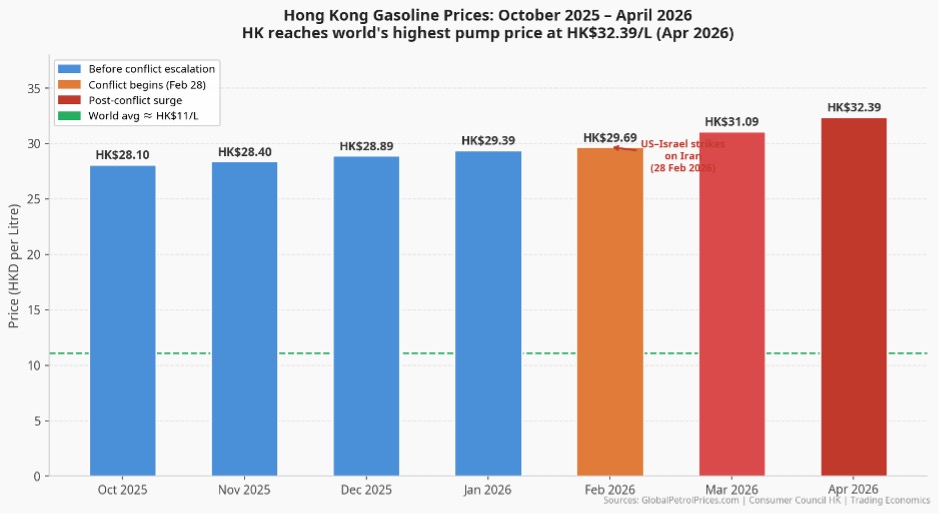
Data sources: GlobalPetrolPrices.com, Consumer Council HK, Trading Economics
Pressure on Domestic Trucking and Last-Mile Delivery
These record-high local fuel prices are adding immense pressure to domestic trucking and last-mile delivery operations in Hong Kong. Diesel prices, which power the majority of the city’s commercial transport fleet, have climbed to between HK$30 and HK$32.97 per litre [8].
The transport sector is feeling the squeeze. Higher operating costs are eroding profit margins for logistics providers, leading to discussions within the industry about implementing temporary fuel surcharges for local deliveries [9].
In response to the crisis, the Hong Kong government recently proposed short-term relief measures, including a two-month diesel subsidy of HK$3 per litre and a 50% reduction in tunnel tolls for non-private vehicles, such as goods vehicles and minibuses [8]. While these measures provide some breathing room for the roughly 100,000 trucks and light goods vehicles in the city, the underlying challenge of elevated fuel costs remains [8].
References
- [1] Al Jazeera. “How badly has the Iran war hit the global economy? The tell-tale signs.” March 16, 2026. https://www.aljazeera.com/news/2026/3/16/the-tell-tale-signs-how-bad-has-the-iran-war-hit-the-global-economy
- [2] World Economic Forum. “The global price tag of war in the Middle East.” March 12, 2026. https://www.weforum.org/stories/2026/03/the-global-price-tag-of-war-in-the-middle-east/
- [3] The Guardian. “Middle East war creating ‘largest supply disruption in the history of oil markets’.” March 12, 2026. https://www.theguardian.com/business/2026/mar/12/middle-east-war-creating-largest-supply-disruption-in-the-history-of-oil-markets
- [4] BSI Freight. “Air Freight Rates Surge 2026: China to US & Europe Shipping Costs Rise.” April 2026. https://www.bsifreight.com/knowledge/industry-news/air-freight-rates-surge-2026
- [5] Flexport. “Middle East Escalation Disrupts Global Ocean and Air Freight Networks.” April 7, 2026. https://www.flexport.com/blog/middle-east-escalation-disrupts-global-ocean-and-air-freight-networks/
- [6] GlobalPetrolPrices.com. “Hong Kong gasoline prices, 06-Apr-2026.” April 6, 2026. https://www.globalpetrolprices.com/Hong-Kong/gasoline_prices/
- [7] Consumer Council Hong Kong. “Oil Price Watch.” April 8, 2026. https://oil-price.consumer.org.hk/en
- [8] South China Morning Post. “Diesel subsidies, cheaper tolls to help Hong Kong transport sector as fuel costs soar.” April 9, 2026. https://www.scmp.com/news/hong-kong/hong-kong-economy/article/3349450/hong-kong-roll-out-relief-measures-transport-sector-fuel-costs-soar
- [9] South China Morning Post. “Surcharges considered as Hong Kong fuel prices set to rise amid Iran war.” March 9, 2026. https://www.scmp.com/news/hong-kong/hong-kong-economy/article/3345934/surcharges-eyed-hong-kong-fuel-prices-set-rise-amid-iran-war
Frequently Asked Questions (FAQ)
Why are global fuel costs rising so rapidly in 2026?
The primary driver is the escalating geopolitical conflict in the Middle East, particularly the disruptions around the Strait of Hormuz, which has severely constrained global oil supplies and caused crude prices to surge.
How is the air freight industry responding to higher fuel costs?
Airlines are implementing significant jet fuel and war-risk surcharges. Additionally, rerouting flights to avoid conflict zones has reduced global air cargo capacity by up to 20%, leading to higher freight rates and longer transit times.
What is the current price of gasoline in Hong Kong?
As of April 2026, Hong Kong has the highest gasoline prices globally, with standard petrol reaching HK$32.39 per litre (approx. US$4.13 per litre).
How are rising fuel prices affecting local deliveries in Hong Kong?
Record-high diesel and petrol prices are significantly increasing operating costs for domestic trucking and last-mile delivery. This has prompted the government to offer temporary diesel subsidies and toll discounts, while the transport sector considers delivery surcharges.
Where can I check the latest auto-fuel prices in Hong Kong?
You can monitor the latest local pump prices and discounts through the Consumer Council’s Oil Price Watch.
Navigating the Volatility with NECL
The logistics and transportation industry is heavily affected by this crisis, with higher operating costs impacting every link in the supply chain—from overseas manufacturing to local warehousing and final distribution.
During times of extreme market volatility, having a reliable and agile logistics partner is crucial. At Nippon Express NEC Logistics Hong Kong (NECL), we leverage our global network, advanced IT solutions like our Visibility platform, and deep industry expertise to help our clients optimize their supply chains. By improving route planning, consolidating shipments, and providing real-time data, we work tirelessly to mitigate the impact of rising fuel costs and keep your business moving forward.